


The storage is emerging as the missing piece to integrate the expansion of renewable, stabilize revenues and convert the energy in an industrial advantage
- The third Day of Energy Storage and its Value Chain, organized by Power Electronics, Universitat de València and the Universitat Politècnica de València, was held on the 11th of June of 2026 at the facilities of Power Electronics, in Llíria (Valencia), bringing together more than a hundred professionals in the sector of renewable energies.
Spain has proved that it can install renewable at high speed. The next challenge is more difficult: to ensure that this power comes when the system needs to generate enough income to support new investments. During the third Day of Energy Storage and its Value Chain, promoters, manufacturers, technology centres, associations and operators agreed on a central idea: the transition has ceased to be measured only in megawatts installed. From now on it is measured in megawatts manageable.
Four data that marked the day
- 17,5 €/MWh price environment captured by the pv during the last year, according exposed Javier Costa, Kenergy.
- The 20% of the hours of sunshine recorded prices, zero, or negative, in accordance with the same procedure.
- 20 GW of new capacity and 80 GWh of storage for 2030 was the scenario posed by Ánder Teeth.
- The electricity consumption of the world’s data centres could more than double this decade, according to Christian Soler.
A system with a lot of energy and little ability to move it
The expansion of photovoltaics has changed the structure of the electricity market. A growing part of the production is concentrated in the same hours, so that the abundance of solar energy reduces your own price and increases the exposure to the restrictions and discharges. Javier Costa, director of Development of Kenergy, stood the average price captured by the pv 17,5 €/MWh during the last year, and added that the 20% of the hours of sunshine were recorded prices are zero or negative. The figures are exposed during the day, but its meaning goes beyond the specific value: produce more already does not guarantee to capture more value.
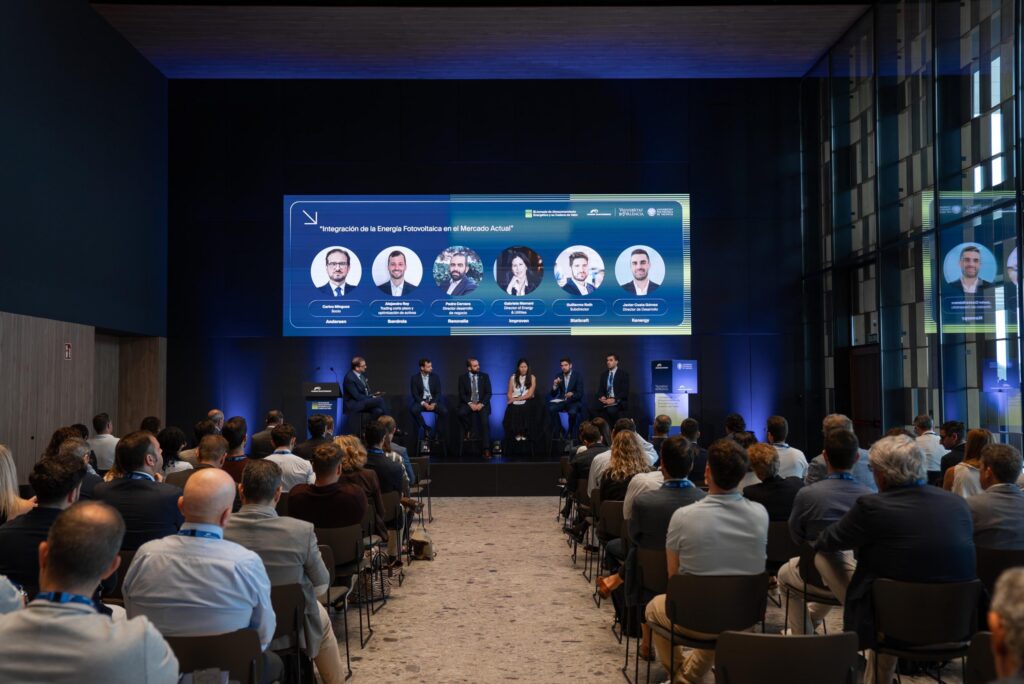
The first roundtable, moderated by Carlos Mínguez, of Andersen put a name to that stage change: the pv must move from a model based on install volume to another focused on creating value, to provide flexibility and to provide services to the system. Gabriela Mamani, of Improven, summed up the challenge as the step \”volume-to-value\”. The photovoltaic you must stop acting as a technology that simply injects energy to become an asset capable of responding to the system: save, move, production, control voltage, participate in adjustment services and provide power when the grid needs it.
The result is a business model that is more sophisticated. The income already will not be a single sale of energy, but the combination of arbitration, markets, balance, tension control, contracts with consumers and future mechanisms of ability to. William Roth, of Statkraft described this basket as a set of parts that can reduce the volatility and facilitate the financing. The european authorization of a mechanism endowed with 9,000 million euros over ten years, it was presented in the table as one of the news most relevant to the sector, precisely because it can provide a stable part of the income.
- \”The main challenge for photovoltaic technology is moving from volume to value.\”
– Gabriela Mamani, Improven
demand Planning, not only the generation
Ánder Molars, president of Endurance Motivate, opened the day with a comparison deliberately provocative. If a well is essential as the pharmacy needs planning and control, he argued, the energy system cannot be limited to accumulate objectives of power without review if the claim, networks, and storage are moving at the same pace. Your second image —the \”bingo cards\”— pointed to the permissions of access and connection to remain quiet for years without changing necessarily in real amenities.
Wisdom suggested an exercise alternative planning for 2030. On the basis of a demand, more prudent than the originally planned for electrification, industrial, electric vehicle, hydrogen and data centers, raised 20 GW of new capacity storage, equivalent to about 80 GWh in systems of four hours. Not presented in the figure as the official goal, but as a result of your own scenario. The value of the proposal was in the method: review annually the relationship between supply, consumption, networks, and flexibility, rather than relying solely on goals you have set a decade vista.
The demand was, in fact, one of the contradictions repeatedly during the day. The system needs new consumption absorb the renewable generation, but many industries are still finding difficulties to electrificarse or access to power. At the same time, projects, data centers and storage compete for capacity at the nodes where it is not always clear how much space is actually used and how much remains blocked by pending requests. The transition will not be resolved by installing independently generation, batteries, and consumption: the three parts should be planned as a single system.
A battery is not an automatic extension: it is a business decision
The participants of the first table they avoided to present the storage as an automatically guarantee of profitability. A battery adds flexibility, but also costs, degradation, and new operational decisions. The question, as stated by the representation of Improven, it is not only if it can be installed, but what risk reduces and what revenues enabled.
The configurations observed in the market are focused today, as explained by Javier Costa in systems where the LFP of between two and four hours. But there is a duration of at universal. A battery designed to arbitration journal is not designed like the other-oriented quick adjustment; nor do they have the same value, an installation hybridized with photovoltaics and an independent system connected to the network. Power, power, number of cycles, degradation, strategy, operation and capacity of replenishment affect the economic result.
Alexander King, of Iberdrola added a structural perspective: Spain must not forget the pumped hydroelectric energy. The batteries provide modularity, speed of response and deployment time more reduced; the pumping brings large volumes of energy, long service life and storage of longer duration. The conclusion was not to choose a technology winner, but build a portfolio capable of responding to different needs.
He also appeared in a warning, temporary. The first projects will be able to capture better income markets, yet little of our competitors. Afterwards, the cannibalization: when a lot of batteries to pursue the same service, the price of that service will fall. The competitive advantage will be arriving soon, but above all in reach with a project is well configured, permissions, and advanced a strategy of operation credible.
Innovation: the chemistry of the software, and from the lab to the market
The second round table, moderated by Eugenio Dominguez, Vice president of AEPIBAL extended the conversation to new architectures and applications. The interventions addressed the hybridization of technologies with profiles of power and energy is different, the industrial energy management, testing and safety, technology transfer and the role of distributed storage and control software.
The common message was that the innovation is not limited to, find a chemistry better. Power electronics, BMS, prediction and algorithms of operation determine how long a battery, how security works and what services it can provide. In hybrid systems, the control decides what technology responds to a peak of milliseconds, and one which delivers energy for several hours. The \”brain\” of the system can be just as important as the cell.
The table also pointed to a bottle neck less visible: the talent. Juan Gilabert, of ITE, summed up the situation with a phrase clear: \”It’s our time\”. The demand for specialists in batteries, power electronics, security, simulation, and operation grows faster than the training offer. The deployment can be found before a human limit that a technological one if universities, technological centres and enterprises do not accelerate the formation.
Data centers: the race for artificial intelligence will gain energy
The presentation of Christian Soler, director of Product and Applications of Power Electronics, moved the discussion to the new demand associated with the artificial intelligence. In a traditional data center works with racks of between 5 and 15 kW and profiles are relatively stable. In the new centers-oriented AI, the power per rack can reach, as stated, about 130 km. Added to this is a cooling can account for between 30% and 40% of the total consumption.
The challenge is not just the volume of energy, but the violence of the load changes. Thousands of processors can be synchronized and cause variations that a gas turbine or a weak network are not prepared to continue to support. Soler submitted several architectures of storage and conversion. The sensing of load can reduce the peaks observed by the network of around 60%-70%; a solution line-interactive with inductance can lead to the reduction of 80%-90%; and the double conversion allows to decouple virtually complete consumption of the data center network, albeit with a penalty in efficiency.
The temporal dimension increases the problem. A data center can be built in less than two years, while strengthening the network or develop new generation firm may require more than five. Soler pointed out that the clusters of computation associated with artificial intelligence is located at between 100 and 300 MW, and Power Electronics as seen projects of the order of gigawatts. He also warned that the network is not prepared to connect immediately points of 300 MW or even to 1 GW. \”This race will be won or lost by the power\”, he concluded. For the system, the data centers can be an opportunity for new demand; without coordination, they can also increase the use of fossil generation local and compete for a network capacity as low.
- \”This race will be won or lost by the energy.\”
– Christian Soler, Power Electronics
the diagnosis of The most uncomfortable: Spain arrives late
The last panel, moderated by José Manuel Enríquez, of Cajamar, raised the critical tone. José María González Moya, director general of APPA, he claimed that Spain had been years in the making mistakes by not developing storage at the rate of renewable generation. His example was immediately: during the day the market recorded negative prices in hours of sunshine, while at night the gas would charge prices much higher. Cheap energy exists, but the system still doesn’t know to move it on time.
José María González Moya contributed the figure more powerful of the day: as stated, until April 2026, 23.4% of the pv production potential would not have taken it. The rapporteur himself presented the data as the \”overrun\” cumulative solar photovoltaic (pv) and linked to the lack of storage. The figure is reproduced as an estimate on display at the table and served to illustrate the magnitude of the mismatch between installed capacity and capacity for integration.
Peter Fresco, director of Avaesen, considered the scenario of 20 GW raised by Ánder Wisdom could stay short and believed that Spain would need more than 20 GW of batteries, probably a figure close to 30 GW, with systems of four hours duration. It was not a conclusion consensus or official goal, but a position that reinforced the urgency of the debate: Spain may need to rhythms of installation of batteries comparable to those that have reached the pv.
The urgency also came to the supply chain. Xavier Thomas, of Hithium warned of the recent spike in the carbonate of lithium, contracts are increasingly indexed to the market and a tariff of 6% which, as noted, will affect certain batteries imported from January 2027. His recommendation was straightforward: to ensure supply capacity before that match the avalanche of projects, trade restrictions, and the volatility of the raw materials.
The regulation runs behind the technology
The main consensus of the table was not technological, but rather administrative. The regulation recognizes better each time, the strategic nature of the storage, but the execution continues fragmented between 17 frames autonomic, environmental criteria and different procedures that are still not treated as homogeneous hybridization, a stand-alone system or an active distributed.
Pedro Cervera, of Renovalia, described how the rules on installed power and transformers-sharing may complicate projects that, in theory, should accelerate the integration of renewable energy. Other participants claimed that add a battery to a plant already authorised should be brought closer to an administrative notification and not to a new processing complete. The difference between authorize in days or in months you can decide which projects to take advantage of aid, shut funding and come to market.
The funding depends on the stability. A bank can understand the technology, but you need to rely on the income of the next ten or fifteen years. The capacity mechanism may provide the basis foreseeable; the rest should come from the market. The more you change the rules, the greater will be the cost of capital. The grants can accelerate the deployment, but not a substitute for a signal of prices stable or foreseeable procedures.
Deploy batteries not tantamount to create industry
The meeting took place in the Valencia Region, a territory with companies of power electronics, integration, engineering, and technology centers able to capture a significant part of the value chain. But install imported containers not enough to create industry. The value is split between design, software, BMS, converters, component manufacturing, integration, installation, operation, maintenance, recycling and second life.
Europe hardly compete only on price with the scales asian. Your opportunity is in the safety, traceability, quality control, technical service and environmental compliance. Interventions on storage marino, self-consumption and industrial distributed systems showed in addition that the market is not limited to large power plants connected to the grid. Ships, factories, businesses and homes will demand different solutions, with requirements of safety and operation.
The third Day he left so a conclusion less comfortable than the usual message of technological optimism. The storage has proven its utility and its costs have declined strongly during the past few years, but the day also warned of a spike in recent lithium carbonate and of a higher volatility in the supply. The opportunity, therefore, is not guaranteed. To turn it into a competitive advantage, Spain should coordinate what until now has advanced separately: generation, demand, networks, markets, permissions, talent and industry. The goal can not be installed more megawatts. You should be getting each megawatt renewable you have a moment, service, and value.
